CELTIC-NEXT Strategic Research & Innovation Agenda (SRIA) 2026-2032
CELTIC-NEXT is an industry-driven, ICT Cluster, operating under the Eureka Clusters Programme (ECP). It acts as a collaborative mechanism for advancing ICT innovation across Europe and the wider EUREKA members’ network. The initiative brings together major ICT companies, service providers, SMEs, research institutions, and academia to enable a secure, trusted, and sustainable digital society. Most importantly, CELTIC-NEXT is committed to securing market, technological, and scientific leadership for the participating partners. The Strategic Research and Innovation Agenda (SRIA) 2026–2032 provides the basis for the ICT Community to research, develop and innovate in relevant ICT technologies and their fields of applications (Industry Verticals) that are strategic for the EUREKA Countries and beyond. This document was prepared under the revised Eureka Clusters Programme (ECP) guidelines to capture the agreement between the CELTIC-NEXT community and the supporting National Authorities to instigate and foster a programme of international collaborative projects as an EUREKA Cluster in the ICT domain for a foreseen period of seven years (2026-2032).
“This newly revised CELTIC-NEXT Eureka Cluster’s Strategic Research and Innovation Agenda (SRIA) now outlines our shared vision for the next generation of ICT communications that will be necessary for growing a secure, trusted, and sustainable digital society over the next five years. The vision reflects that CELTIC-NEXT is an industry-driven initiative involving all the major ICT industry players and many SMEs, service providers, and research institutions. The CELTIC-NEXT activities are open to all organisations that share the CELTIC-NEXT vision of an inclusive digital society and are willing to collaborate to their benefit, aligned with their national priorities, to advance the development and uptake of advanced ICT solutions.”
David Kennedy, Chairman, CELTIC-NEXT Eureka Cluster
The dawn of 6G technology marks a pivotal moment in global telecommunications, promising transformative ICT capabilities that extend far beyond the advancements of 5G. This agenda outlines a comprehensive strategy for 6G research and innovation, providing a roadmap for telecom professionals, researchers, and policymakers. It articulates the 6G vision, establishes key research domains, and proposes innovation strategies, stakeholder roles, and policy recommendations to ensure Europe and the wider EUREKA members’ network remain at the forefront of future connectivity.
The evolution from 1G to 5G has fundamentally redefined how societies communicate, work, and innovate. As we approach the era of 6G, the convergence of digital, physical, and biological worlds is accelerating, driven by exponential increases in data, intelligence, and connectivity demands. Global trends—such as the proliferation of artificial intelligence, immersive applications, and the Internet of Everything—necessitate a strategic agenda to guide research, innovation, and deployment of 6G technologies. This agenda aims to provide a unified direction to harness 6G’s and the wider upcoming ICT techs’ potential for economic growth, societal benefit, and technological leadership.
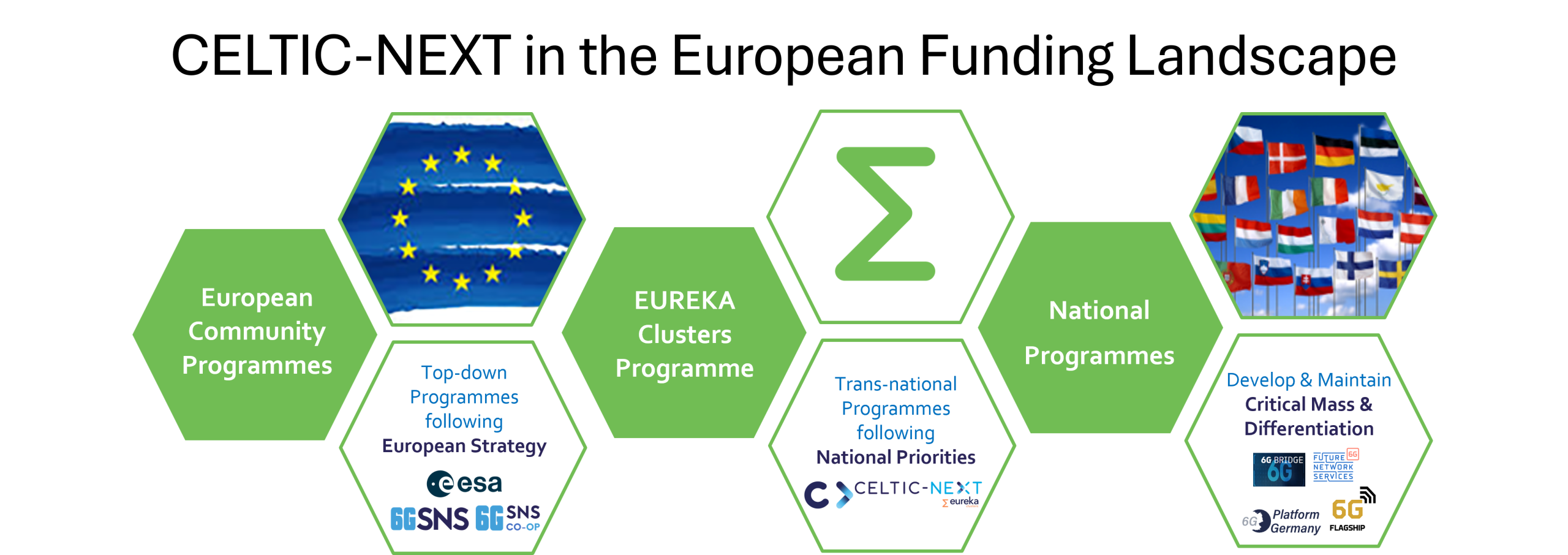
The CELTIC-NEXT SRIA 2026–2032 sets out a comprehensive roadmap for EUREKA Countries’ leadership in ICT, beyond 6G itself, expanding to vertical industry sectors. It builds on CELTIC-NEXT’s holistic, bottom-up approach, taking into account the European 6G Vision (6G-IA), the SNS-JU SRIA, and vendor perspectives, in a topical and, over time, TRL-staged manner.
Key messages:
- AI‑native networks must be designed from inception. Networks shall use AI, but also provide services to other industries’ AI applications, in a mutually beneficial collaboration.
- Sustainability and energy efficiency must be both system intrinsic properties and societal enablers.
- Beyond communication services (sensing, positioning, computing) will define 6G, supporting the always-increasing convergence of digital, physical and biological worlds.
- Eureka Countries’ sovereignty in ICT value chains is critical.
- Societal responsibility (ethics, privacy, inclusion, trust) must be embedded.